Austin Ruthyn's will
Uncle SilasAustin Ruthyn's will is the legal instrument that makes Maud a wealthy heiress and, at the same time, places her under Silas Ruthyn's personal authority. It gives the trustees control of the estate for Maud's benefit, but requires her to live at Bartram-Haugh under her uncle's guardianship until she is twenty-one. Austin intended this arrangement as a public vindication of Silas; its structure instead binds Maud's safety and inheritance to the man whose conduct comes under scrutiny.
The will's provisions and distribution of property
The will is first glimpsed through Madame de la Rougierre's pointed questions. She presses Maud to say whether Austin has made a will, when it was written, and what it contains, arguing that an intestate estate could cost Maud a great deal. Maud says she knows nothing of any will and that her father's love is enough. The exchange establishes the document's importance before its contents are disclosed: an inheritance that Maud does not yet know about is already a subject of probing interest.
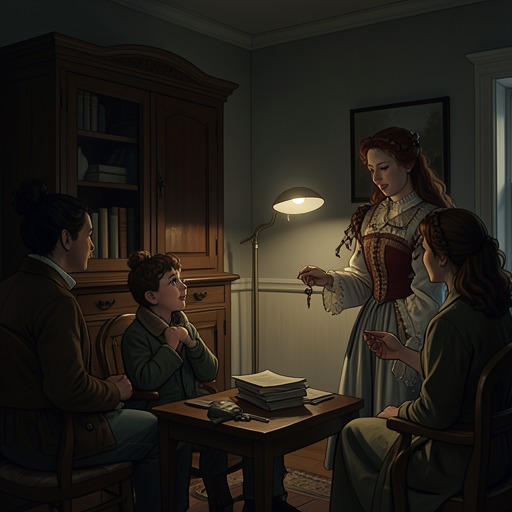
At the formal reading, Austin leaves his real and personal property, copyrights, leases, money, rights, and other possessions to four trustees: Lord Ilbury, Mr. Penrose Creswell, Sir William Aylmer, and Hans Emmanuel Bryerly. The estate is held in trust for Maud, subject to a bequest of £15,000 to Austin's brother, Silas Ruthyn, and £3,500 to each of Silas's two children. Silas is also given the use of Bartram-Haugh and adjoining lands for his natural life at an annual rent of five shillings, under conditions governing waste. A codicil gives legacies to servants, £1,000 to Monica Knollys, and £3,000 to Doctor Bryerly for his work as trustee. The reading makes the division of roles plain: the trustees hold and administer the property, Maud is its principal beneficiary, and Silas receives specified benefits rather than outright ownership of the estate.
Guardianship as a test of Silas
The will's most consequential provision appoints Silas Maud's sole guardian, granting him full parental authority until she turns twenty-one. She is to reside under his care at Bartram-Haugh, and the trustees are to pay him £2,000 yearly for her maintenance, education, and expenses during the guardianship. The arrangement does not simply transfer money: it gives Silas authority over Maud's person while directing a substantial annual payment to him for her upkeep.
Austin's private instructions explain why he chose this unusual settlement. In letters to the trustees, he describes Silas as oppressed and unhappy, and says that the guardianship should demonstrate that his brother, who knew him best, had confidence in him. Austin connects this confidence to the slander surrounding Silas, which he characterizes as politically motivated, and calls the guardianship an ordeal of purification. If Maud dies before reaching adulthood, Austin says, the entire property will go to Silas; in the meantime, he entrusts Silas with her person, believing she will be as safe with him as in her father's care. The arrangement therefore has two linked purposes: to entrust Maud to Silas and to make that trust evidence against the scandal attached to him.
Risk embedded in the settlement
Doctor Bryerly warns Maud that the arrangement carries a severe contingency: if she dies before turning twenty-one, the entire property passes to Silas, while he already has custody of her and authority over her daily life. The will thus concentrates guardianship and a possible financial benefit in the same person. Maud initially hesitates to grasp the implication, but Bryerly says that the more he considers the trust, the less he likes it. His concern exposes a tension Austin's language of confidence cannot resolve: the will is intended to rehabilitate Silas, yet its terms make Maud's survival and welfare central to the settlement's outcome.
Silas's financial circumstances sharpen the practical stakes. His son Dudley complains that his father has no available money, that the trustees will not release funds until they receive a legal opinion, and that Silas refuses to give him money despite his bills and lawyers' letters. Dudley threatens to sell Silas's books and jewels. The episode distinguishes the value of the estate from immediately accessible cash and shows how trust administration can frustrate a household's demands for money. It also places the will's financial structure amid the family's debts and competing expectations, rather than treating the inheritance as a simple transfer of wealth.
Administration, dispute, and consequences
The will's separation of trusteeship from guardianship becomes contentious when Doctor Bryerly challenges Silas's handling of the estate. He argues that Silas is exercising a power he does not lawfully possess and that the effect is to impoverish the estate to Silas's benefit and Maud's detriment. Silas rejects the accusation and insists that his honour should not be impugned. The confrontation gives the will continuing force after its reading: its provisions supply the grounds on which the management of Maud's inheritance can be questioned.
Maud later offers Silas £20,000 of her own money to help him, but he refuses, saying that accepting would expose him to the plausible accusation that he had unduly influenced his young ward. He presents refusal as a matter of conscience and emphasizes that an execution may soon occur at the house. His response shows how the guardianship limits even Maud's voluntary use of her inheritance: Silas claims that accepting her offer would compromise his position, while her minority leaves him responsible for interposing himself between her and dealings with her property. In a separate proposal, Dudley offers to take her away from Bartram-Haugh in return for a written promise of the same £20,000. Maud rejects the bargain and points out that she can visit Lady Knollys whenever she pleases.
The will's effects are visible in the physical estate as well as in these disputes. Maud and Mary Quince pass ranks of felled, barkless oaks marked with red chalk and Roman numerals, apparently prepared for sale. Maud believes Silas may be legally entitled to act as he has, but mourns the loss of the old trees that had served as family landmarks for centuries. The scene distinguishes legal authority from its material consequence: even where the guardian's actions seem lawful, the estate entrusted for Maud's benefit can be diminished in ways that cannot readily be undone.
Narrative significance
Austin's will converts a father's confidence into an institutional arrangement whose protections and hazards are inseparable. Trust ownership, a life tenancy, guardianship, annual maintenance payments, and a remainder contingent on Maud's death distribute legal power among several people, but leave Maud herself living under Silas's authority. The private letters deepen that contradiction by framing the settlement as a moral vindication, while Bryerly's warning and later challenge direct attention to its financial and personal risks.
The document also shapes Maud's choices well beyond the reading. It places her at Bartram-Haugh, makes Silas responsible for her care, and gives her inheritance a central role in disputes over money, estate management, and whether she may act independently. Its governing irony is that the proof Austin devised to clear his brother depends on Maud's dependence upon him: the will asks the reader to regard that dependence as evidence of trust, while its terms make the trust itself a source of vulnerability.